Resonance in a Damped, Driven Oscillator
November 2026
- oscillator
- damping
- resonance
- quality factor
Abstract
A mass on a spring is the simplest system that resonates. We write down its equation of motion, sort its free motion into three regimes, and derive how strongly it answers a periodic push. Move the sliders to change the damping and watch the curves redraw. The detailed derivation lives in a separate appendix, the measurements in lab notes, and an animation in a small web page.
1 Introduction
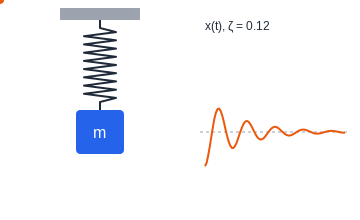
Bridges sway in the wind, a radio picks out one station, and atoms absorb light of one colour. Each of these is a resonance: a system with a natural frequency answers very strongly when it is pushed at that frequency. The mass on a spring in figure 1 shows all of it with a single equation.
This report is one of a set of linked files. The same paper written as an ordinary LaTeX manuscript is in classic/paper.tex (compiled by pdflatex: paper.pdf), a Korean edition is in report.ko.htex, and the shared notation comes from macros.htex.
2 The model
Let be the displacement from equilibrium. The spring pulls back with force , friction resists with , and an external force drives the mass. Newton's second law gives
| (1) |
Dividing by leaves two numbers that describe the oscillator completely:
| (2) |
the natural frequency and the damping ratio, so that (1) becomes
| (3) |
3 Free motion
Without the drive () the solutions are with . The sign of decides what happens (table 1).
| Regime | Damping ratio | Motion |
| Underdamped | oscillates while the amplitude decays | |
| Critically damped | returns fastest without overshooting | |
| Overdamped | creeps back without oscillating |
In the underdamped case, which matters most for resonance, the motion is (appendix, equation 3)
with the damped frequency . Figure 2 draws this solution for the current damping ratio .
Theorem 1 (Energy only decreases). For free motion the energy satisfies .
4 Forced motion and resonance
After the free motion has died away, the mass follows the drive: . Writing for the frequency ratio, the amplitude and phase are
Try in (3): .
Divide by : .
Take the modulus and the argument:
(4)
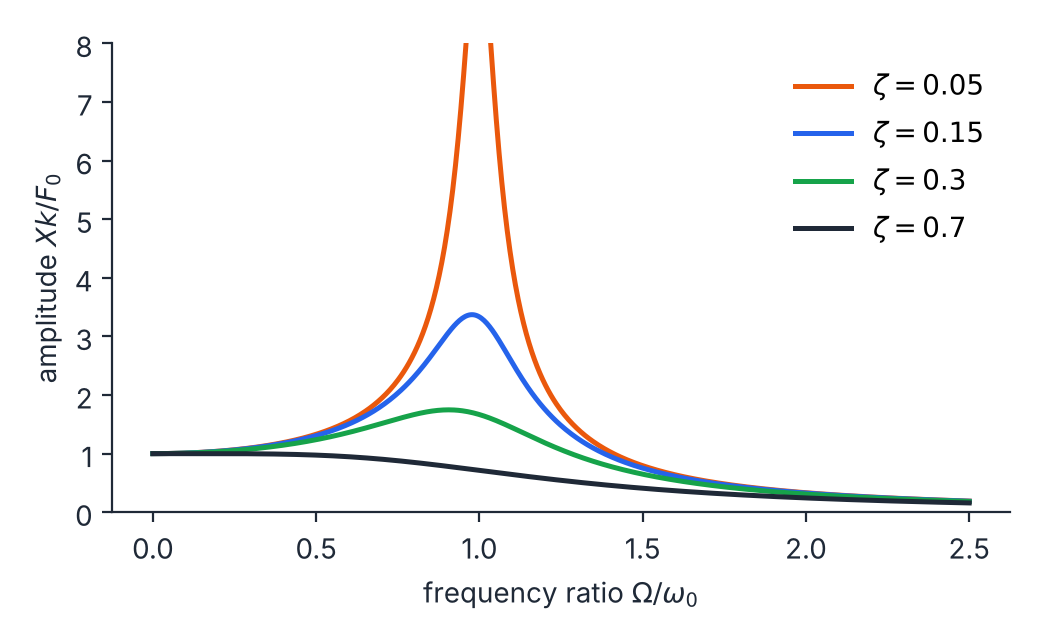
Proposition 2 (Resonance peak). If , the amplitude (4) is largest at , where
| (5) |
Proof
The amplitude is largest where is smallest. Setting gives , which is positive only if . Substituting back gives .
∎The number is the quality factor: a lightly damped oscillator has a tall, narrow peak. Drag the slider and watch figure 3: at the peak sits near and grows as shrinks. Figure 4 compares four damping ratios at once.
5 Measurement
A cart on an air track with two springs was driven by a motor at several frequencies (the numbers in this example are simulated for illustration). Table 2 gives the values fitted from the data in the lab notes; the peak height agrees with (5) to within the measurement error.
| Quantity | Value | Uncertainty |
| Natural frequency | 1.62 Hz | 0.01 Hz |
| Damping ratio | 0.061 | 0.004 |
| Quality factor | 8.2 | 0.5 |
| Peak amplitude | 8.0 | 0.6 |
6 Conclusion
Two numbers, and , fix everything: where the peak is, how tall it is (proposition 2), and how fast free motion dies out. The textbook treatments in [1] and [2] cover the same ground at more length; [3] treats resonance in systems with many degrees of freedom.
References
- [1] A. P. French, Vibrations and Waves, W. W. Norton (1971), chapters 3 and 4.
- [2] J. R. Taylor, Classical Mechanics, University Science Books (2005), chapter 5.
- [3] L. D. Landau and E. M. Lifshitz, Mechanics, 3rd ed., Pergamon (1976), §26.
- [4] Wikipedia, Q factor.