Heat Flow in a Rod and Fourier Series
November 2026
- heat equation
- diffusion
- Fourier series
- separation of variables
Abstract
A metal rod is hot in the middle and cold at both ends. The heat equation says how the temperature evens out, and Fourier's idea of writing any profile as a sum of sine waves solves it: each wave fades on its own, the short ones fastest. Slide time forward to watch the profile relax, or change the number of terms to see how a sum of smooth waves builds a sharp edge.
1 The heat equation
Let be the temperature of a thin rod of length whose ends are held at zero. Heat flows from hot to cold at a rate proportional to the temperature gradient (Fourier's law), and energy is conserved, which together give
| (1) |
where is the thermal diffusivity of the material [1]. Figure 1 shows the answer before we derive it: a hot block in the middle spreads into a smooth hump that sinks towards zero.
2 Separation of variables
Look for solutions of the form . Then (1) becomes , and both sides must equal one constant, .
with allows only , , so .
gives .
Add up the modes:
(2)
The coefficients come from the starting profile. For a rod with that is at temperature 1 between and and 0 elsewhere,
| (3) |
Proposition 1 (Short waves die first). Mode decays with time constant . After a time of order only the first mode is left.
Proof
The factor in (2) is with as stated. The ratio of mode to mode 1 is , which tends to zero for every .
∎3 Watching it relax
Figure 2 sums the first 15 terms of (2) with at the time set by the slider, . At the sharp block appears; by the curve is almost a single sine arch, as proposition 1 predicts.
4 How sine waves make a corner
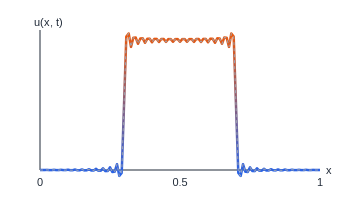
At the series must reproduce a profile with jumps. Figure 3 adds up the first terms. More terms sharpen the edges, but an overshoot of about 9% of the jump stays next to each one however many terms are used: the Gibbs phenomenon [2].
5 Real materials
The first time constant tells how long a rod takes to cool. Table 1 uses room-temperature diffusivities [3] for a rod of length m.
| Material | (m/s) | |
| Copper | 3.8 min | |
| Aluminium | 4.4 min | |
| Stainless steel | 1.7 h | |
| Window glass | 21 h |
Each Fourier mode behaves like an overdamped oscillator that only decays; compare the three regimes in the oscillator example. Diffusion with a source term is also the continuum version of the spreading in the SIR example.
References
- [1] J. Fourier, Théorie analytique de la chaleur, Firmin Didot, Paris (1822).
- [2] W. A. Strauss, Partial Differential Equations: An Introduction, 2nd ed., Wiley (2008), chapter 5.
- [3] Wikipedia, Thermal diffusivity, table of values.